
Do you provide diaphragm seals with gold plating?
Yes. We supply diaphragm seals with a gold-plated diaphragm on request. The thin gold layer reduces hydrogen permeation through the diaphragm, so it is used for hydrogen service and for media that release hydrogen. Tell us the medium, pressure and temperature, and we will confirm the right seal.
Which diaphragm and wetted-part materials can you supply?
Standard wetted parts are SS 316 or 316L. For corrosive media we offer Hastelloy C, Monel 400, Duplex, Super Duplex, Inconel, Titanium, Tantalum and PTFE-coated diaphragms on request. Tell us the medium and we will suggest the material.
Are your gauges made to EN 837, ASME B40.100 and IS 3624?
Yes. Our gauges are manufactured to EN 837, ASME B40.100 or IS 3624 (the Indian Standard for Bourdon tube pressure and vacuum gauges), as your specification requires. Tell us the standard and accuracy class when you enquire.
Do you supply calibration certificates and test reports?
Yes. A calibration certificate and test report can be supplied with each gauge, with readings at several points of the scale and details of the reference standard used. You can view a sample certificate on our Quality page.
Is your calibration traceable?
Yes. Our reference standards are calibrated at regular intervals and are traceable to national standards. Each certificate shows the reference standard used and its calibration details.
Can you support third-party inspection?
Tell us when you enquire if your project needs third-party or customer inspection, and we will confirm the arrangements and the documents.
What dial sizes and connections are available?
Common dial sizes are 63, 100 and 150 mm, with other sizes on request. Connections include 1/4 inch and 1/2 inch BSP or NPT, bottom or back entry, and flanged or clamp-type connections on diaphragm seals.
Which pressure units can the dial show?
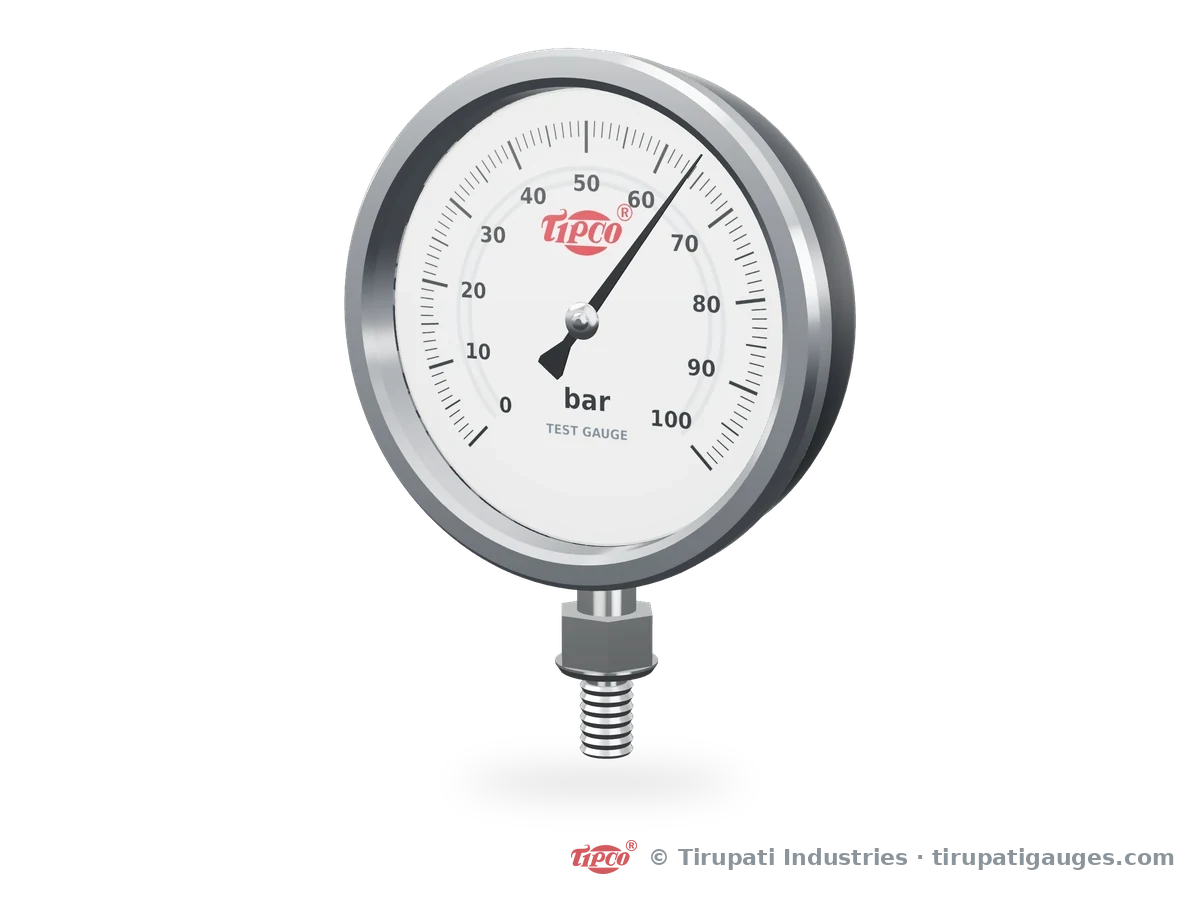
bar, kg/cm², psi, kPa, MPa, mbar and mmWC, as well as dual scales such as bar and psi.
Can the dial carry our logo, a tag number or a red mark?
Yes, on request. We can print your logo or a tag number on the dial, or add a red mark at the working or maximum pressure.
How long does delivery take?
Typical delivery times from the date of order acceptance: standard gauges in common ranges 3 to 6 weeks; made-to-order gauges with a special range, dial or connection 4 to 7 weeks; diaphragm seals and special materials 6 to 9 weeks; high-pressure gauges up to 3000 bar 6 to 8 weeks. We confirm the exact date in every quote.
How quickly do you reply to an enquiry?
We reply to quote requests within 1 working day. For urgent needs, call or WhatsApp +91-7045908585, Monday to Saturday, 9:30 am to 6:00 pm IST.
What is a diaphragm pressure gauge used for?
A diaphragm pressure gauge senses pressure through a thin flexible diaphragm instead of a Bourdon tube. It suits low pressures and viscous, corrosive or crystallising media that could clog or damage a standard gauge.
What is the difference between a capsule gauge and a Bourdon tube gauge?
A Bourdon tube gauge measures medium to high pressures with a curved tube that straightens under pressure. A capsule gauge uses two thin discs welded together and is made for very low pressures, such as air and non-corrosive gases.
Why choose a glycerine-filled pressure gauge?
The glycerine fill damps the needle and lubricates the movement, so the gauge reads steadily and lasts longer where there is vibration or pulsating pressure.
What does a snubber do?
A snubber, also called a pulsation damper, restricts sudden pressure surges before they reach the gauge. It protects the gauge and gives a steadier reading.
What does a siphon tube do?
A siphon, or pigtail, holds a small amount of condensed water that cools the steam before it reaches the gauge, so hot steam cannot damage the sensing element.
What is the highest pressure you can supply?
We make gauges for pressures up to 3000 bar, with world-class accuracy. Send us your range, medium and connection and we will confirm the right model.
How do I choose the pressure range?
The normal working pressure should sit in the middle of the scale. As a guide, keep steady pressure below about 75% of full scale, and lower for fluctuating pressure.
What is the difference between a pressure gauge and a manometer?
A manometer measures pressure by the height of a liquid column, and is mostly used for very low pressures. The word is also used loosely for dial pressure gauges. If you are not sure which you need, describe the pressure range and we will recommend one.
Why use a thermowell with a temperature gauge?
A thermowell protects the stem from pressure, flow and corrosion, and allows the thermometer to be removed and replaced without opening the process.
What should I tell you when I ask for a quote?
Send the gauge type, dial size, pressure range and unit, connection type and size, material of the wetted parts, the medium and its temperature, and the quantity. If you are not sure of any item, send what you have and we will help.