
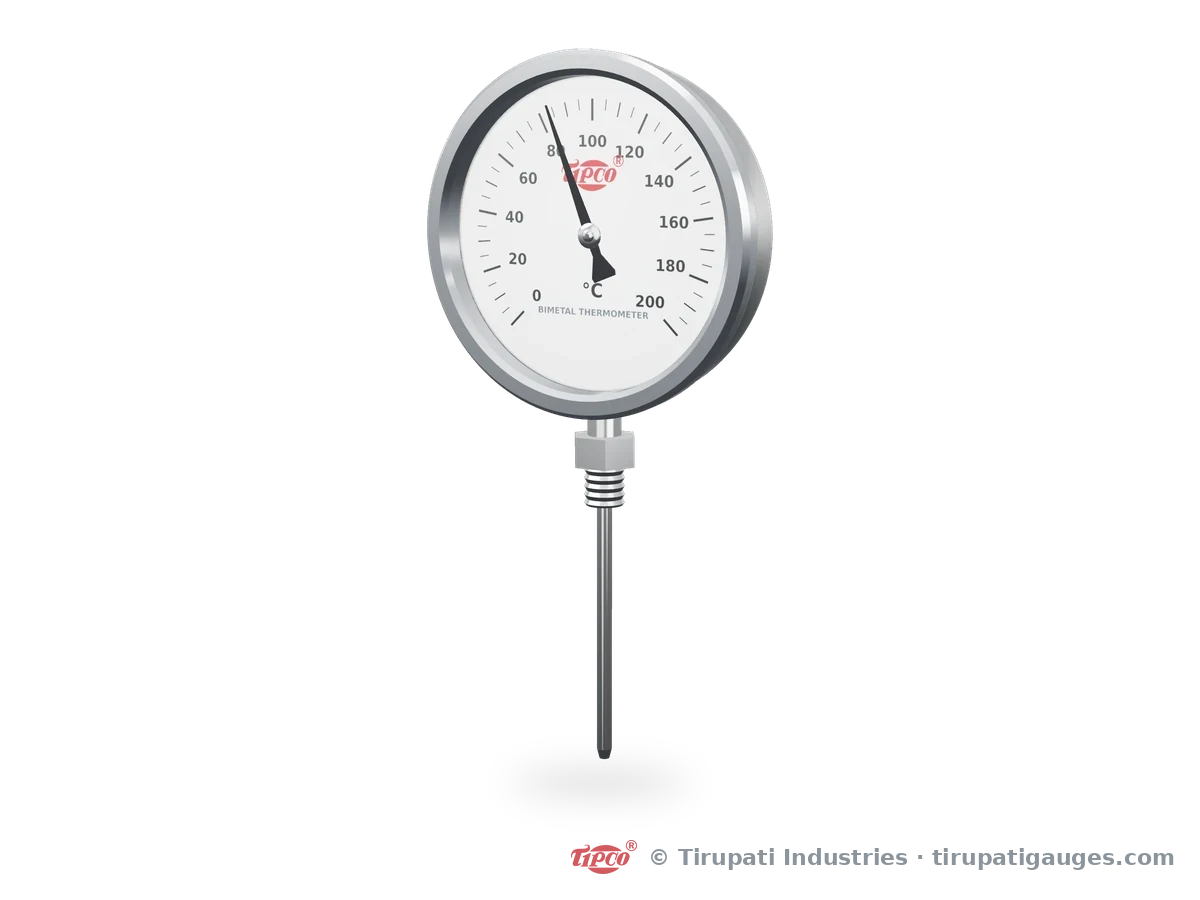
What it is
A bimetallic temperature gauge uses a coiled strip of two bonded metals inside the stem. It needs no fill fluid or power, which makes it simple and rugged.
Available with bottom or back entry, in the stem length your process needs, and with thermowells to suit.
How it works
The two metals expand at different rates. As the temperature changes, the helical bimetal coil winds or unwinds, and that rotation turns the pointer directly.
Where it is used
- Pipelines and heat exchangers
- Tanks and vessels
- Boilers, steam and hot water
- HVAC and chilled water
- Food and process equipment
Things to consider
- Choose the stem length so the sensing part sits fully in the medium.
- Use a thermowell so the thermometer can be removed without stopping the process.
- Choose bottom or back entry to suit the mounting position.
What to tell us for a quote
- Temperature range
- Dial size and stem length (or capillary length)
- Connection and thread size
- Need for a thermowell
- The medium and its working pressure
- Quantity
Questions about bimetallic temperature gauges
How accurate is a bimetal thermometer?
Accuracy depends on the class and range. Tell us the accuracy you need when you enquire.
Do I need a thermowell?
Use one wherever the point is under pressure or flow, or the medium is corrosive, so the thermometer can be changed without opening the process.
Not sure this is the right gauge?
Answer up to 5 quick questions and the Gauge Finder suggests the right one from our range.
Need bimetallic temperature gauges?
Send us the range, medium and connection and we will quote.